

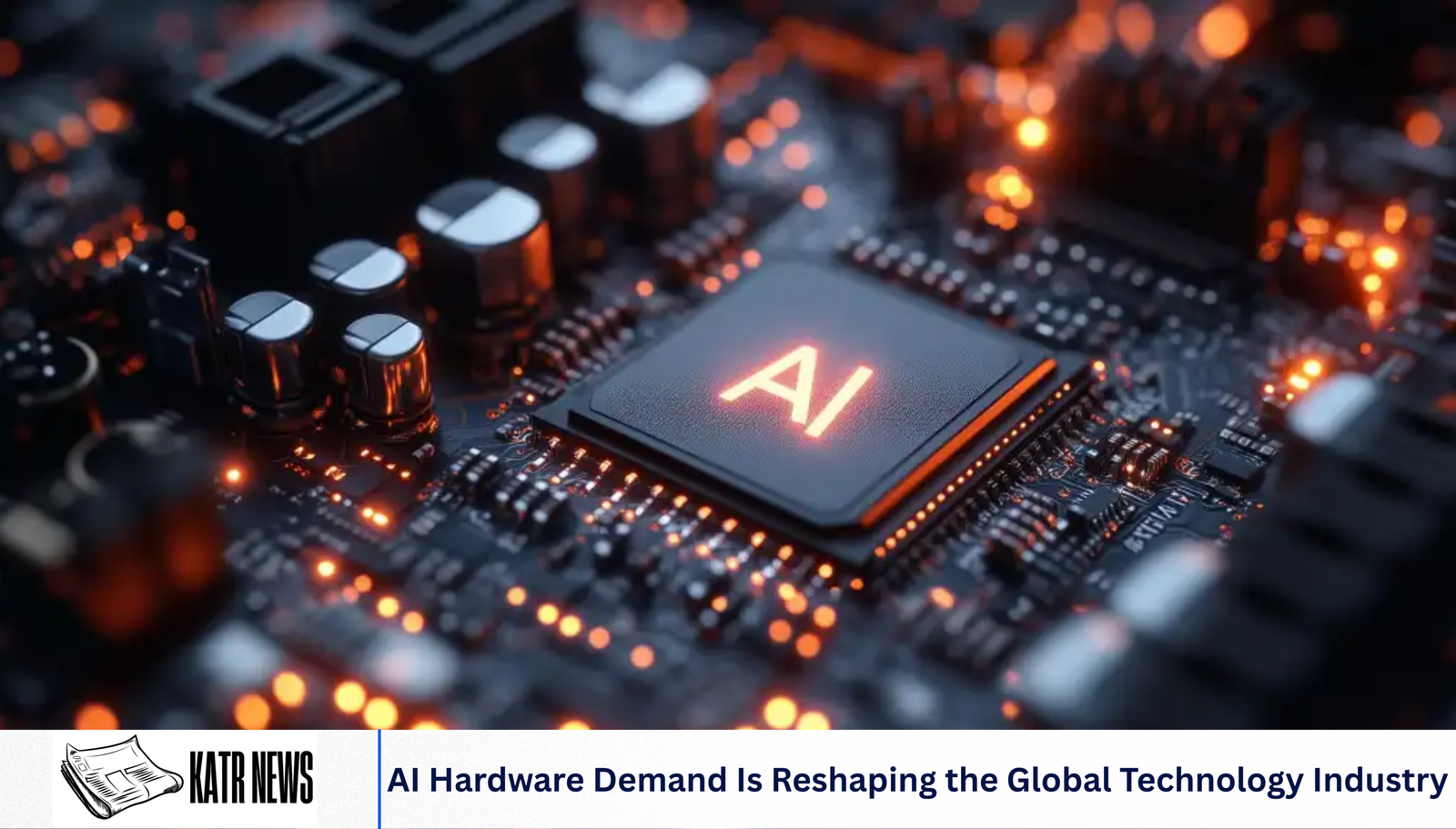
Artificial intelligence is changing the technology industry at a speed that is creating strong demand for new hardware. As companies develop more capable AI models and deploy them across cloud services, business applications, research, and consumer products, the need for powerful processors, memory, networking equipment, storage, and data center infrastructure continues to increase.
This growing demand is affecting much more than chip manufacturers. Data center operators, semiconductor suppliers, networking companies, cooling providers, power infrastructure businesses, and hardware manufacturers are all adapting to the requirements of modern AI workloads. Gartner expects worldwide IT spending to reach about $6.32 trillion in 2026, with data center systems among the fastest-growing areas.
AI Is Driving a New Hardware Cycle
Traditional technology hardware has often followed relatively predictable upgrade cycles. Businesses typically replaced servers, computers, and networking equipment after several years. AI is changing that pattern because advanced models require significantly more computing capacity.
Training large AI models can require thousands of high-performance processors working together. Running those models for millions of users also requires substantial computing resources. As AI adoption expands, companies are investing in larger data centers and more specialized hardware to handle these workloads.
Deloitte says AI is reshaping enterprise hardware through the rapid expansion of AI servers, next-generation data centers, and hybrid computing architectures. The company also identifies data center systems as one of the fastest-growing areas of technology spending.
Growing Demand for AI Chips
AI accelerators have become a central part of the new hardware market. Graphics processing units, custom accelerators, and other specialized processors are being designed to handle the mathematical workloads used by modern AI systems.
Gartner forecasts that AI semiconductors will represent around 30% of total semiconductor revenue in 2026. The firm also expects global semiconductor revenue to exceed $1.3 trillion this year, with AI processing, data center networking, power requirements, and memory demand contributing significantly to growth.
Companies are also developing their own custom AI chips. Cloud providers such as Google and Amazon are investing in application-specific processors designed for their own infrastructure and workloads. This gives large technology companies another option alongside commercially available AI accelerators.
Data Centers Are Being Redesigned
AI workloads are changing the physical design of data centers. Traditional servers were not built for the extremely high power and computing densities required by the newest AI systems.
Modern AI infrastructure can require much more electricity per rack than conventional computing systems. Higher power consumption also creates additional heat, making advanced cooling systems increasingly important.
Deloitte reports that next-generation AI data centers are driving demand for higher-power distribution, liquid cooling, high-speed networking, and other specialized infrastructure. Some AI racks are expected to operate at hundreds of kilowatts, significantly above the power levels associated with traditional racks.
This means AI hardware demand is creating opportunities for companies that do not manufacture processors themselves. Power systems, cooling equipment, optical networking, storage, and data center construction are all becoming important parts of the AI infrastructure market.
Memory Has Become a Critical Component
AI systems require large amounts of high-speed memory to process information efficiently. High-bandwidth memory, commonly known as HBM, has become particularly important for advanced AI accelerators.
Strong AI demand has placed pressure on the supply of advanced memory. Omdia reported that AI demand was exceeding available production capacity in areas including HBM, advanced packaging, and semiconductor manufacturing, with some constraints expected to continue into 2027.
Gartner has also forecast significant increases in memory prices during 2026. According to its semiconductor forecast, DRAM prices could rise sharply as demand from AI infrastructure competes with other technology applications for limited supply.
Higher memory costs can eventually affect other technology products because memory is used in servers, smartphones, PCs, and many other devices.
Networking Is Becoming More Important
AI computing is not only about processors. Thousands of accelerators may need to communicate with one another rapidly while training or operating large models.
This creates demand for faster networking equipment and technologies that can move enormous amounts of data between processors, memory, and storage systems.
A new group of companies is also working on specialized technologies for AI networking. Reuters reported in September 2026 that Delos Data, a chip startup founded by former Intel engineers, raised $100 million to develop chips and software focused on data movement inside increasingly complex AI data centers.
The development highlights how AI infrastructure is expanding beyond traditional processor competition.
Hyperscalers Are Increasing Infrastructure Spending
Large cloud providers are among the biggest buyers of AI hardware. Companies operating massive cloud platforms are investing heavily in processors, servers, networking equipment, storage, and new data centers.
TrendForce estimated that the combined capital expenditure of nine major cloud service providers could exceed $886.7 billion in 2026. The research firm also raised its forecast for AI server shipments to nearly 31% year-over-year growth.
This level of spending demonstrates how AI is influencing the investment decisions of the world’s largest technology companies.
The demand is also encouraging cloud providers to develop specialized hardware rather than relying entirely on third-party processors. Custom chips can be designed around specific workloads and may provide companies with greater control over performance, cost, and energy efficiency.
Nvidia Remains Central to the AI Hardware Market
Nvidia has become one of the most visible companies in the AI hardware industry because of its powerful GPUs and the software ecosystem built around them.
The company continues to invest in new generations of processors and complete AI computing systems. In August 2026, Nvidia projected strong future revenue growth and reported that data center revenue had more than doubled year over year in its latest quarter. Reuters also reported that the company was preparing to expand its next-generation Vera Rubin platform.
However, the market is becoming more diverse. AMD, Google, Amazon, Huawei, and other companies are developing competing processors and computing architectures.
Competition Is Expanding Globally
AI hardware competition is also becoming an important part of the global semiconductor industry.
In China, Huawei has reported strong demand for its AI computing equipment, with production reportedly unable to satisfy domestic demand. The company is accelerating its development of future Ascend processors and large-scale AI computing systems.
China’s semiconductor industry is also expanding its memory production capabilities. Reuters reported in September 2026 that CXMT had entered mass production with a new generation of DRAM technology and was working to strengthen its position in the global memory market.
These developments show that AI hardware competition is increasingly connected to broader semiconductor supply chains and national technology strategies.
Energy Is Becoming a Major Technology Issue
The growth of AI hardware also creates a growing need for electricity. Large data centers require significant amounts of power to operate processors, networking equipment, cooling systems, and storage.
The International Energy Agency reported that capital expenditure by major technology companies had already exceeded $400 billion in 2025 and was expected to increase substantially in 2026. It also noted that AI-focused data center capacity has expanded rapidly.
As a result, access to reliable and affordable electricity is becoming an important factor when companies decide where to build new AI infrastructure.
Data center development can therefore affect energy markets, construction, utilities, and local infrastructure in addition to the technology sector.
AI Hardware Costs Remain a Challenge
The rapid expansion of AI infrastructure also creates financial challenges. Advanced processors are expensive, while data center construction, networking, cooling, electricity, and maintenance add further costs.
Deloitte has noted that AI hardware demand is creating strong growth for the technology sector but that companies still face questions about whether increased hardware revenue can translate into sustainable profitability.
Supply constraints can also increase costs. When demand for processors, memory, advanced packaging, or networking equipment rises faster than production capacity, companies may have to pay higher prices or wait longer for components.
These pressures could influence the cost of AI services for businesses and consumers.
The Supply Chain Is Changing
AI hardware demand is forcing technology companies to pay closer attention to their supply chains. Advanced AI systems depend on multiple stages of production, including chip design, semiconductor manufacturing, advanced packaging, memory production, networking, assembly, and data center deployment.
A shortage at any one of these stages can affect the wider system.
Omdia has identified HBM, advanced packaging, and semiconductor manufacturing capacity as important bottlenecks for AI hardware.
This is encouraging companies to invest in additional manufacturing capacity and alternative suppliers. It is also increasing interest in domestic semiconductor production in several parts of the world.
AI Hardware Is Affecting Consumer Technology
Although data centers are currently at the center of AI hardware demand, the effects are also reaching consumer devices.
Smartphones, laptops, PCs, and other devices are increasingly being designed with AI processing capabilities. Specialized neural processing units and AI accelerators can allow certain workloads to run locally rather than relying entirely on cloud servers.
At the same time, higher memory prices can increase the cost of consumer devices. Gartner expects device spending to rise in 2026 but notes that higher memory costs are creating pressure on prices and replacement cycles.
This creates a mixed situation for consumers. AI features are becoming more common, but the hardware needed to support them can also increase manufacturing costs.
The Long-Term Infrastructure Outlook
The expansion of AI infrastructure could continue for many years as companies build computing capacity for training and running increasingly capable models.
PwC projects that global AI infrastructure investment could reach $31.6 trillion cumulatively through 2050 under its baseline scenario. The company estimates annual data center capital expenditure could rise from roughly $800 billion in 2026 to $1.8 trillion by 2050.
Such forecasts are estimates rather than guaranteed outcomes. Future investment will depend on AI adoption, model development, hardware prices, energy availability, regulation, and the economic returns generated by AI applications.
Nevertheless, the scale of current investment shows that AI hardware is no longer a narrow semiconductor story. It is becoming a major part of the global technology infrastructure.
What the Hardware Shift Means for the Technology Industry
The growth of AI is changing which technologies receive investment and how technology companies design their infrastructure.
Processors remain essential, but AI systems also require advanced memory, fast networking, storage, cooling, power management, and specialized data center equipment. This creates a much broader hardware ecosystem around AI.
Companies that can improve computing efficiency may become increasingly important as customers look for ways to reduce the cost and energy requirements of AI workloads.
The industry is also likely to see continued competition between general-purpose GPUs, custom AI accelerators, CPUs, networking processors, and other specialized architectures.
Frequently Asked Questions
Why is AI increasing demand for hardware?
AI models require large amounts of computing power, memory, storage, and networking capacity. As businesses and consumers use more AI services, companies need additional infrastructure to train and operate those systems.
What hardware is most important for AI?
AI systems rely on several types of hardware, including GPUs and other AI accelerators, high-bandwidth memory, CPUs, networking equipment, storage systems, cooling infrastructure, and power systems.
Why is high-bandwidth memory important for AI?
High-bandwidth memory allows AI accelerators to access large amounts of data quickly. This makes it an important component for training and running advanced AI models.
How is AI changing data centers?
AI is pushing data centers toward higher power densities, faster networking, advanced cooling, and specialized server designs. Some modern AI racks require far more power and cooling capacity than traditional computing systems.
Will AI hardware demand continue growing?
Industry forecasts point to continued growth, although the exact pace is uncertain. Future demand will depend on AI adoption, model development, infrastructure costs, energy availability, and the economic value of AI applications. Gartner expects semiconductor revenue to exceed $1.3 trillion in 2026, with AI semiconductors representing a significant share of the market.
Conclusion
AI hardware demand is reshaping the global technology industry by driving investment in processors, memory, networking, data centers, cooling, power infrastructure, and semiconductor manufacturing. The growth of AI is also creating new competition among hardware companies and increasing the importance of efficient computing and reliable supply chains. As AI adoption continues, hardware will remain a central part of the technology industry, while the scale of future investment will depend on how quickly AI capabilities, applications, costs, and infrastructure requirements develop.
