

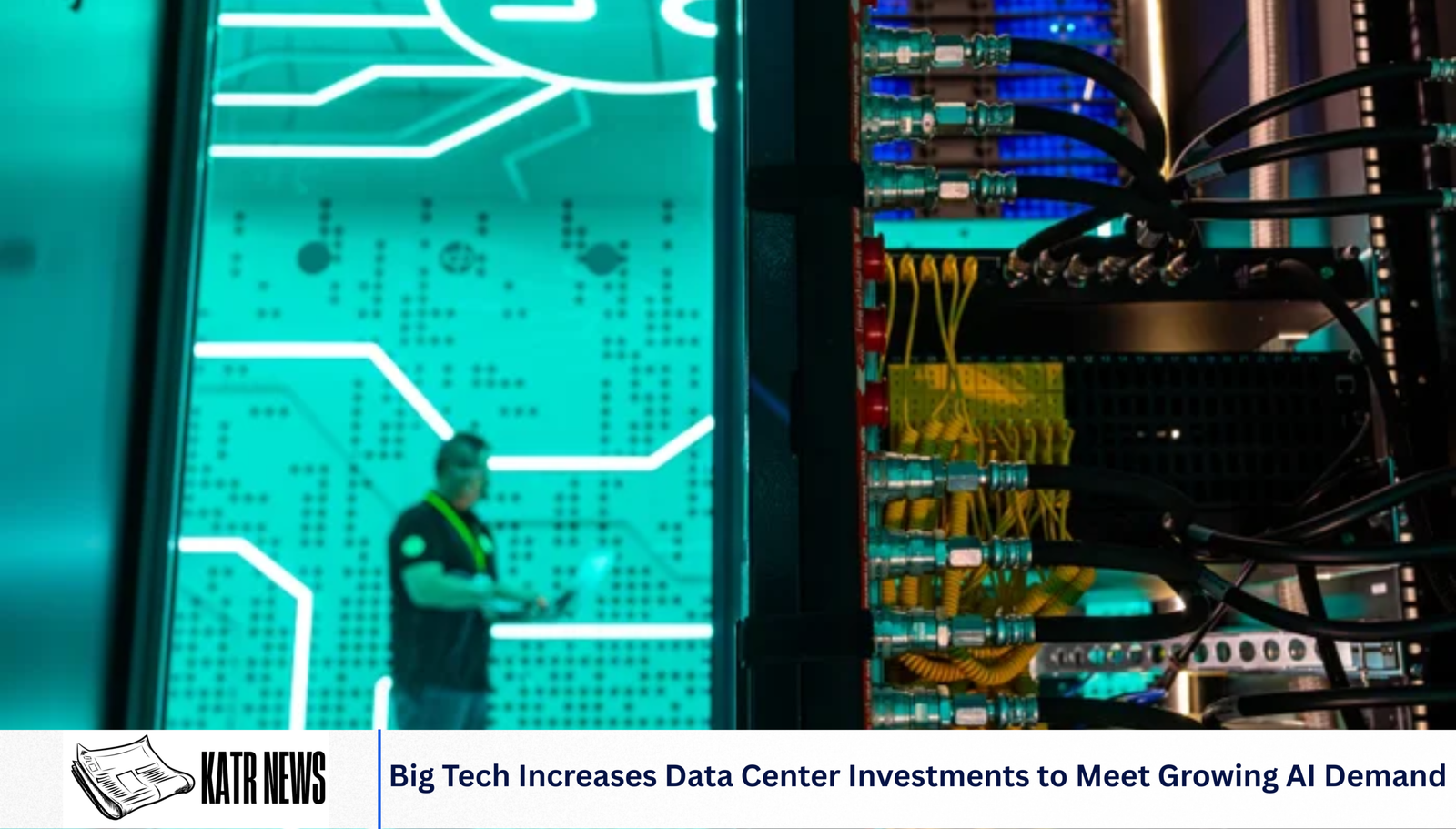
Artificial intelligence is changing the technology industry at a remarkable pace, and the demand for computing power is growing alongside it. Behind every AI chatbot, image generator, coding assistant, recommendation system, and advanced model is a large amount of computing infrastructure. As AI services become more capable and widely used, technology companies are investing heavily in the data centers needed to support them.
Big Tech companies are expanding their infrastructure to handle this growing demand. These investments involve much more than adding servers. Companies need powerful AI chips, networking equipment, cooling systems, electricity, buildings, and reliable connections to the internet. The result is a major transformation in how technology infrastructure is planned and built.
Why AI Requires So Much Computing Power
Traditional software applications can operate with relatively modest computing resources. AI models are different because training and running advanced models can require enormous amounts of processing power.
Training a large AI model involves processing huge quantities of data. Powerful processors work together for extended periods to identify patterns and improve the model’s performance.
Once a model is released, computing demand does not stop. Every user request requires processing. As millions of people interact with AI services, the infrastructure supporting those services must handle a growing number of requests.
This creates demand for increasingly large and sophisticated data centers.
Data Centers Are Becoming the Foundation of AI
Data centers have always been important to the technology industry, but AI is increasing their strategic importance.
A modern AI-focused data center can contain thousands of specialized processors working together. These facilities also require high-speed networking systems so that information can move between processors efficiently.
Power and cooling are equally important. AI processors can generate significant amounts of heat while operating at high performance, requiring sophisticated cooling systems.
As a result, building an AI data center is a complex engineering project involving technology, construction, energy, networking, and environmental considerations.
AI Chips Are Driving Infrastructure Expansion
One of the biggest changes in data center design is the growing importance of specialized AI processors.
Graphics processing units, or GPUs, became particularly important because they can perform many calculations simultaneously. This makes them well suited to the mathematical workloads involved in modern AI.
Other companies are also developing specialized AI accelerators designed specifically for machine-learning workloads.
The availability of these processors can influence how quickly companies can expand their AI services. Data center investment therefore goes hand in hand with demand for advanced computing hardware.
Cloud Providers Are Expanding Capacity
Cloud computing companies are among the most important players in the AI infrastructure market.
Large cloud platforms provide computing resources that businesses and developers can access without building their own data centers.
As demand for AI services grows, cloud providers need to expand the amount of computing capacity available to customers.
This can involve building new facilities, expanding existing locations, installing more processors, and improving networking infrastructure.
For customers, cloud-based AI infrastructure can make advanced computing more accessible. For cloud providers, it creates a need for continuous investment.
AI Training and AI Inference Have Different Demands
Not all AI workloads require the same type of infrastructure.
Training involves teaching a model using large datasets. This can require huge amounts of computing power over extended periods.
Inference happens when an already-trained model generates an answer, image, prediction, or other result in response to a request.
As AI becomes part of more applications, inference demand is becoming increasingly important. A model may be trained once but then used millions or billions of times.
This means companies need infrastructure that can support both large-scale training and high-volume everyday usage.
Electricity Has Become a Major Issue
One of the biggest challenges associated with data center expansion is electricity.
Large facilities can consume substantial amounts of power, particularly when they contain high-performance AI processors.
As technology companies expand data center capacity, they must secure reliable electricity supplies. This can create new relationships between technology companies, utilities, energy producers, and local governments.
The growth of AI is therefore becoming connected to broader questions about energy infrastructure.
Renewable Energy Is Getting More Attention
Because data centers require large amounts of electricity, companies are also looking at ways to reduce the environmental impact of their operations.
Renewable energy projects can help companies increase the amount of clean electricity associated with their operations.
Solar and wind projects are among the technologies being developed and expanded in many regions. Some companies also use long-term energy agreements to secure renewable electricity.
However, renewable energy availability does not automatically solve every infrastructure challenge. Data centers need reliable power around the clock, while some renewable sources depend on weather conditions.
This makes energy storage, grid development, and diverse power sources important parts of the broader discussion.
Cooling Is Another Major Challenge
High-performance computing generates heat, and AI processors can produce substantial amounts of it.
Traditional air cooling can become less practical as computing density increases. This has encouraged greater interest in advanced cooling technologies.
Liquid cooling is one approach that can remove heat more efficiently from high-density computing systems.
As AI data centers become more powerful, cooling technology is likely to become increasingly important.
The design of a data center must balance computing performance, energy efficiency, reliability, and temperature management.
Data Center Construction Is Accelerating
The growing demand for AI computing is creating new opportunities in the construction and infrastructure industries.
Technology companies and their infrastructure partners are developing large facilities designed specifically for high-performance computing.
These projects can take significant time because they involve land acquisition, building construction, electrical infrastructure, networking, cooling systems, and equipment installation.
The scale of some projects also means that planning decisions can affect local communities and regional infrastructure.
Location Matters
Data centers are not built randomly.
Companies consider electricity availability, network connectivity, land, cooling requirements, regulations, taxes, and access to skilled workers when selecting locations.
A location with abundant electricity and strong fiber connectivity can be attractive for a large computing facility.
Some regions are becoming important technology infrastructure hubs because they can provide several of these advantages at the same time.
However, rapid development can also create pressure on local electricity grids and other public infrastructure.
Networking Is Just as Important as Computing
AI workloads often distribute tasks across many processors.
Those processors need to communicate with one another quickly. Slow networking can reduce the efficiency of expensive computing hardware.
Modern AI data centers therefore rely on high-speed networking systems designed to move large amounts of information between servers.
As AI models grow larger, networking technology becomes an increasingly important part of overall performance.
This means the AI infrastructure race is not simply about who has the most processors. Companies also need efficient systems for connecting those processors.
Big Tech Is Building More Specialized Infrastructure
Traditional data centers were designed to support a wide range of workloads, including websites, databases, applications, and cloud services.
AI is encouraging companies to create facilities optimized for machine learning.
These facilities can be designed around high-density computing, specialized accelerators, advanced networking, and powerful cooling systems.
The result is a shift toward infrastructure that is increasingly tailored to specific workloads.
The Cost of AI Infrastructure Is Rising
Building advanced data centers requires significant capital.
Companies must spend money on buildings, land, electrical equipment, cooling, networking, processors, and other hardware.
The cost does not end once a facility opens. Data centers require continuous maintenance and upgrades as computing technology changes.
AI development can therefore become a long-term infrastructure commitment rather than a one-time technology investment.
For large technology companies, the scale of these investments reflects expectations that AI services will remain an important part of the technology industry.
Smaller Companies Also Benefit From the Expansion
Although major technology companies are responsible for many large infrastructure projects, smaller businesses can also benefit from expanded computing capacity.
Cloud providers allow startups and developers to rent computing resources instead of purchasing and maintaining expensive hardware.
This lowers the barrier to experimenting with AI.
A small company can build an AI-powered application using cloud infrastructure without owning a large data center.
As more computing capacity becomes available, developers can potentially experiment with larger and more sophisticated AI applications.
Data Center Expansion Could Affect Consumers
The infrastructure race may seem distant from ordinary users, but consumers are already experiencing its effects.
AI features are being added to smartphones, search engines, office applications, social networks, creative software, and many other products.
Those services require computing infrastructure somewhere.
As AI becomes more common, the amount of computing required to support everyday digital experiences can increase substantially.
This means the data center expansion happening today could directly influence the services consumers use in the future.
AI Infrastructure Could Improve Service Reliability
More computing capacity can also help companies improve the reliability of AI services.
When demand suddenly increases, additional infrastructure can provide more capacity for user requests.
Companies can also distribute workloads across multiple data centers, helping reduce dependence on a single facility.
Geographic distribution can improve resilience and potentially reduce delays for users located in different regions.
This becomes increasingly important as AI services move from optional tools to products that businesses and consumers use regularly.
There Are Environmental Concerns
The rapid expansion of data centers has also raised environmental questions.
Large facilities can require significant electricity and water resources, depending on their cooling systems and local conditions.
The environmental impact varies widely between facilities and regions.
Companies are therefore under increasing pressure to improve energy efficiency, reduce resource consumption, and use cleaner energy sources where possible.
The challenge is finding a balance between expanding AI capabilities and managing the infrastructure’s environmental footprint.
Governments Are Paying More Attention
Data center development can have economic benefits for regions that host these facilities.
Construction projects can create jobs, while new infrastructure can support technology-related business activity.
At the same time, governments and communities may need to consider electricity demand, water use, land development, taxes, and other local effects.
This makes data center planning a broader economic and infrastructure issue rather than something that only concerns technology companies.
AI Efficiency Could Change Future Demand
There is an important factor that could reduce some infrastructure pressure: AI models are becoming more efficient.
Researchers and companies are working on techniques that allow models to produce strong results with fewer computing resources.
More efficient chips and software can also reduce the amount of power required for individual AI tasks.
If AI becomes substantially more efficient, companies may be able to provide more services without increasing infrastructure at the same rate.
However, lower computing costs can also encourage more AI usage, potentially creating additional demand.
The AI Data Center Race Is Still Developing
The current wave of investment is part of a much larger transition in the technology industry.
AI is becoming a fundamental layer of digital infrastructure, similar to cloud computing and high-speed internet.
The companies that provide AI services need reliable access to computing power, while hardware manufacturers are developing processors specifically for these workloads.
Data center operators, energy companies, construction firms, and networking providers are all becoming part of the expanding AI ecosystem.
This makes AI infrastructure one of the most important areas of technology investment.
What This Means for the Future
The expansion of AI data centers is likely to continue as businesses integrate artificial intelligence into more products and services.
Future facilities may become more specialized, energy efficient, and densely packed with advanced computing hardware.
Cooling systems, networking technology, power management, and energy generation will all play important roles in determining how efficiently these facilities operate.
At the same time, AI companies will continue looking for ways to reduce the computing resources required for individual tasks.
The future of AI will therefore depend not only on better models but also on the infrastructure capable of running them at global scale.
Frequently Asked Questions
Why do AI companies need so many data centers?
AI services require large amounts of computing power for both training models and processing user requests. As usage grows, companies need additional infrastructure to provide enough capacity.
What is an AI data center?
An AI data center is a computing facility designed or optimized to handle workloads associated with artificial intelligence. It typically uses powerful processors, high-speed networking, and advanced cooling systems.
Why are AI chips important?
AI chips are designed to handle the mathematical operations required by machine-learning workloads efficiently. They can provide the performance needed to train and operate advanced AI models.
Do data centers use a lot of electricity?
Large data centers can consume significant amounts of electricity, especially when they contain high-density AI computing hardware. Power availability is therefore an important factor when companies plan new facilities.
Will AI data centers affect consumers?
Yes. Data center infrastructure supports many AI-powered products and services used by consumers. More infrastructure can provide companies with additional capacity to develop and operate AI features.
Are companies trying to make AI more energy efficient?
Yes. Companies and researchers are working on more efficient processors, software, model architectures, and cooling technologies. These improvements can reduce the resources required for certain AI workloads.
Conclusion
Big Tech’s increasing investment in data centers reflects the growing importance of artificial intelligence across the technology industry. Advanced AI models require enormous computing resources, and supporting them at global scale requires powerful processors, high-speed networking, sophisticated cooling, and reliable electricity. These infrastructure projects can create opportunities for technology development while also raising questions about energy consumption, environmental impact, and local resources. As AI becomes more deeply integrated into everyday applications, data centers will remain a critical part of the technology ecosystem. The future of AI will depend not only on creating smarter models but also on building efficient and reliable infrastructure capable of supporting their growing use.
