

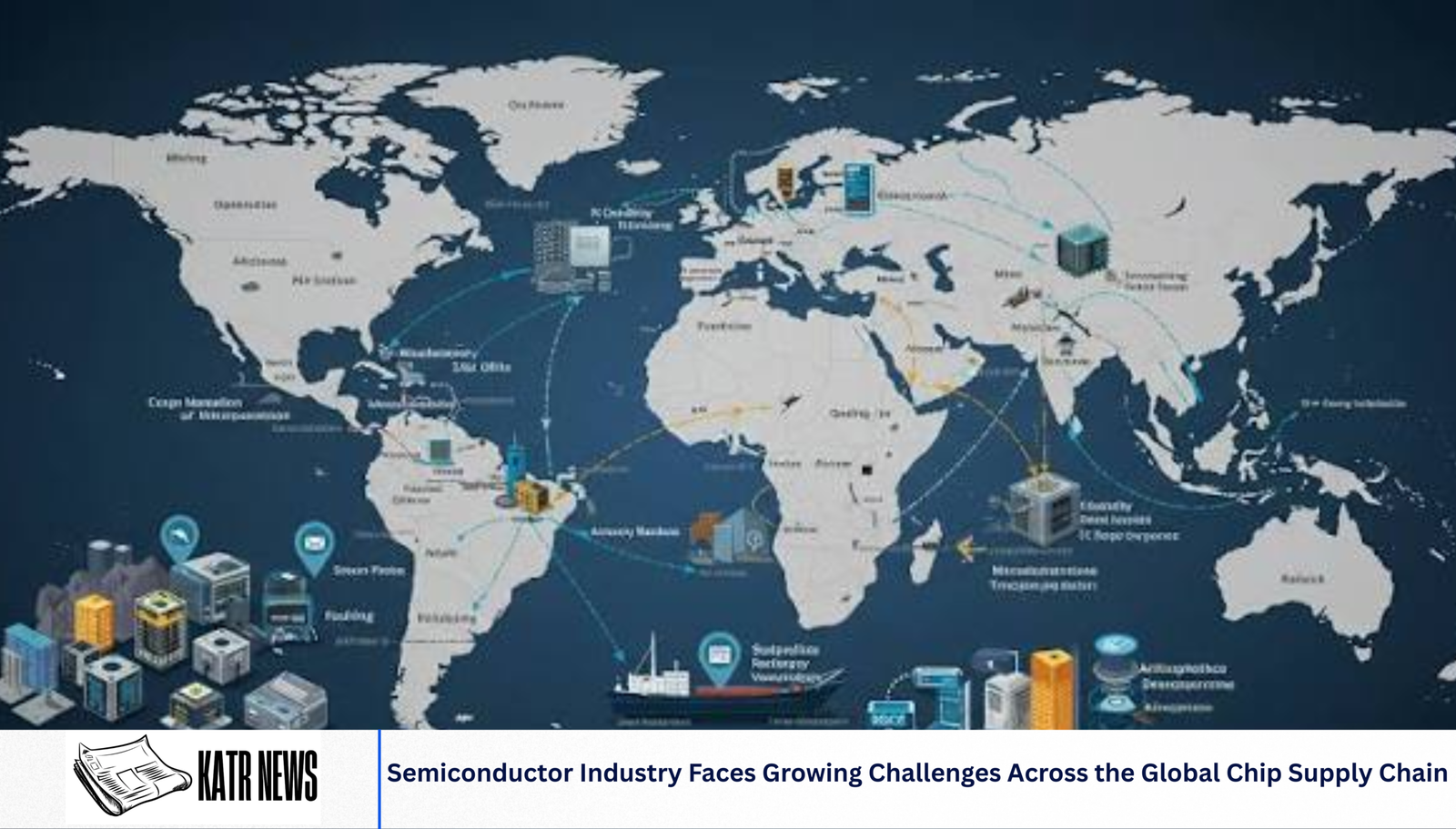
The semiconductor industry is entering another important period as demand for advanced chips continues to rise while manufacturers face growing pressure across the global supply chain. Semiconductors are essential to smartphones, computers, cars, data centers, industrial equipment, artificial intelligence systems, and many other modern technologies.
In 2026, artificial intelligence has become one of the biggest forces shaping the chip industry. AI data centers require powerful processors, advanced packaging, and high-bandwidth memory, creating strong demand for specialized semiconductor products. At the same time, manufacturers are dealing with trade restrictions, geopolitical tensions, limited production capacity, rising costs, energy requirements, and shortages of important materials.
The result is a semiconductor market that is expanding rapidly but becoming more complicated. Industry investment is increasing, yet building new manufacturing capacity takes years. This means that simply announcing new factories does not immediately solve supply problems.
AI Is Changing the Chip Market
Artificial intelligence has become one of the main drivers of semiconductor demand.
Modern AI systems require enormous computing power. Training and operating advanced models requires specialized processors and large amounts of high-bandwidth memory. Cloud companies and data-center operators are therefore investing heavily in AI infrastructure.
TSMC reported strong demand for leading-edge manufacturing in 2026 and said AI-related demand remained extremely robust. The company also raised its expectation for 2026 revenue growth to slightly above 40 percent year over year.
Industry research shows the same trend. A 2026 semiconductor industry survey from KPMG and the Global Semiconductor Alliance found that 73% of surveyed executives identified AI as a major revenue driver, ahead of cloud and data-center applications, wireless communications, and automotive uses.
This strong demand is creating opportunities for chip manufacturers, but it is also putting pressure on the supply chain.
Memory Has Become a Major Pressure Point
One of the biggest challenges is memory.
AI accelerators depend heavily on high-bandwidth memory, or HBM, to move large amounts of data quickly. As chip manufacturers and data-center companies prioritize AI systems, memory production is increasingly being directed toward specialized products.
This can create pressure on supplies of other memory products used in computers, smartphones, and consumer electronics.
S&P Global reported that AI-driven demand was tightening memory availability and increasing electronics costs. The company also said memory producers expected supply pressure to continue as capacity was shifted toward products required for AI systems.
Deloitte’s 2026 semiconductor outlook similarly highlighted the growing demand for HBM3, HBM4, and DDR7 memory and the resulting pressure on conventional consumer memory supplies.
This means the AI boom can affect consumers even when they are not buying AI hardware directly.
Chip Demand Is Not Limited to AI
Although AI is currently one of the strongest growth areas, semiconductors are still required across almost every major technology sector.
Cars use chips for safety systems, navigation, entertainment, battery management, driver assistance, and engine control.
Smartphones require processors, memory, image-processing components, connectivity chips, and power-management semiconductors.
Industrial equipment, telecommunications infrastructure, gaming systems, medical devices, and household electronics also depend on semiconductor components.
KPMG’s 2026 industry survey identified cloud and data centers, wireless communications, and automotive applications as major semiconductor demand drivers alongside AI.
This broad demand makes supply planning difficult. Manufacturers cannot focus entirely on one category because shortages in one part of the market can affect other industries.
Advanced Chip Manufacturing Takes Time
Building semiconductor capacity is not something manufacturers can accomplish quickly.
Advanced chip factories require expensive equipment, highly controlled environments, specialized workers, reliable electricity, water supplies, and complex production processes.
TSMC has said that developing technology, preparing capacity, and reaching high-volume production can take more than five years.
This creates a major challenge for the industry.
Demand can rise rapidly because of a new technology, but production capacity cannot immediately increase at the same speed.
The gap between rising demand and new capacity can therefore continue for years.
Semiconductor Equipment Investment Is Increasing
Manufacturers are responding by spending more on production equipment.
SEMI expects worldwide spending on 300mm semiconductor fabrication equipment to rise 18% in 2026 to approximately $133 billion. It forecasts another 14% increase in 2027, taking spending to about $151 billion.
The investment reflects the need for more advanced manufacturing capacity.
However, equipment spending is only one part of the process. New factories still need to be built, qualified, staffed, connected to utilities, and brought to stable production.
This explains why increased investment does not immediately translate into abundant chip supplies.
Geopolitical Tensions Add More Risk
Semiconductor manufacturing is highly globalized.
Chip designs may originate in one country, wafers may be produced in another, advanced packaging may take place somewhere else, and the final products may be shipped around the world.
This interconnected structure has created efficiency, but it also creates vulnerability.
Political tensions between major economies have increasingly affected semiconductor trade.
The United States has imposed restrictions on certain advanced semiconductor technologies and equipment involving China, while China is investing heavily in domestic chip capabilities.
The issue has become closely connected to broader competition over artificial intelligence and advanced technology.
For manufacturers, this means supply-chain decisions are increasingly influenced by government policy as well as traditional business considerations.
Export Restrictions Are Changing the Industry
Export controls can affect which companies are able to purchase advanced chips, manufacturing equipment, and other semiconductor technologies.
These restrictions are intended by governments to address national-security and strategic concerns, but they also affect commercial supply chains.
For companies operating globally, a change in export rules can require adjustments to product design, manufacturing locations, suppliers, and customer relationships.
The uncertainty can make long-term planning more difficult.
China Is Expanding Domestic Chip Production
China is also increasing efforts to develop its own semiconductor capabilities.
Huawei has reported strong demand for its AI computing products and said current production capacity is not enough to meet domestic demand. The company is developing new AI chips and broader computing systems as China seeks to reduce dependence on foreign technology.
China’s memory industry is also making progress.
In September 2026, Chinese DRAM manufacturer CXMT announced that its fifth-generation memory platform had entered mass production. The company said the new platform improves production efficiency and reduces power consumption compared with its earlier generation.
These developments show how semiconductor manufacturing is becoming increasingly important to national technology strategies.
Critical Materials Are Another Challenge
The semiconductor industry does not depend only on silicon.
Manufacturing also requires specialty chemicals, gases, metals, and other materials.
Some of these resources are concentrated in a small number of countries, creating additional supply risks.
Gallium and germanium are two examples. Reuters reported in September 2026 that restrictions and limited alternative production had contributed to continued price and supply pressures for these materials, which are used in semiconductor and other advanced technologies.
Finding alternative sources is not always easy.
New mining and refining projects can take years to develop, while replacing a material may require changes to manufacturing processes.
Energy Is Becoming a Bigger Issue
Advanced semiconductor factories consume significant amounts of electricity.
The growing AI industry is also increasing demand for data centers, which require large amounts of power to operate advanced computing equipment.
This creates another connection between the semiconductor industry and the broader energy infrastructure.
KPMG’s 2026 semiconductor survey found that some industry executives were concerned about having enough energy to power advanced chip manufacturing facilities.
The challenge is therefore not simply building more chip factories. Manufacturers also need reliable electricity and supporting infrastructure.
Water Is Essential to Semiconductor Manufacturing
Semiconductor factories also require large quantities of highly purified water.
Water is used in various stages of wafer manufacturing and cleaning.
This creates challenges in regions where water resources are limited or vulnerable to extreme weather.
As semiconductor manufacturing expands into new locations, companies and governments must consider whether local infrastructure can support the requirements of advanced fabrication plants.
The Supply Chain Is Becoming More Regional
For decades, semiconductor manufacturing developed through highly specialized global networks.
Now governments and companies are increasingly interested in regional production.
The United States, Europe, China, Japan, South Korea, Taiwan, and other economies are supporting domestic or regional semiconductor capabilities.
The objective is not necessarily to produce every type of chip locally.
Instead, many governments want to reduce dependence on a small number of external suppliers for strategically important technologies.
SEMI says supply-chain restructuring and localized industrial ecosystems are among the factors supporting increased semiconductor manufacturing investment.
Reshoring Has Its Own Challenges
Moving semiconductor production closer to end markets can improve resilience, but it can also increase costs.
A new factory may require substantial government support, private investment, specialized workers, equipment, utilities, and supplier networks.
It can take years before the facility reaches efficient high-volume production.
There is also a risk that building similar capacity in multiple regions could increase overall industry costs.
This means supply-chain diversification involves a balance between efficiency and resilience.
Packaging Is Becoming More Important
Chip manufacturing is not only about producing silicon wafers.
Advanced packaging has become increasingly important because modern AI processors often combine multiple components into sophisticated packages.
High-bandwidth memory, processors, and other components must communicate extremely quickly.
As chip designs become more complex, packaging technology becomes a potential bottleneck.
This is another reason why increasing wafer production alone may not solve every semiconductor supply problem.
The industry needs sufficient capacity across manufacturing, packaging, testing, memory production, and related processes.
AI Data Centers Need More Than Chips
Another important issue is that AI infrastructure requires much more than processors.
Data centers need electricity, cooling systems, networking equipment, storage, transformers, and other infrastructure.
S&P Global has highlighted constraints in electrical components such as transformers and other equipment needed to build and power large data centers.
This means that even if semiconductor production increases, the overall expansion of AI computing can still face bottlenecks elsewhere.
The chip supply chain is therefore connected to a much larger industrial ecosystem.
Tariffs Are Adding Uncertainty
Trade policy is another major factor.
In January 2026, the White House announced measures concerning imports of semiconductors, semiconductor manufacturing equipment, and related products. The administration cited concerns about U.S. dependence on foreign semiconductor supply and proposed a phased approach involving tariffs and trade negotiations.
For semiconductor companies, tariff uncertainty can complicate investment decisions.
Companies may need to reconsider where components are produced, where products are assembled, and how goods move between countries.
This can increase costs even before any actual shortage occurs.
Consumers Could Feel the Impact
Supply-chain problems in semiconductors can eventually reach consumers.
Higher memory prices can affect computers and smartphones.
Higher chip costs can affect cars and other electronic products.
Longer component lead times can delay product launches.
Companies may also redesign products to use alternative components when preferred chips become too expensive or difficult to obtain.
S&P Global has projected continued pressure on electronics costs as AI-driven memory demand competes with consumer and commercial demand.
The impact will vary significantly by product and region.
Smartphones Face Changing Component Costs
Smartphone manufacturers are particularly sensitive to memory and processor prices.
Modern smartphones use increasingly sophisticated memory, processors, cameras, connectivity components, and AI capabilities.
As manufacturers compete for advanced components, device makers may face difficult decisions about pricing and specifications.
Some companies may absorb higher costs, while others may adjust product prices or specifications.
Consumers could therefore see different effects depending on the manufacturer and product category.
Computers and Gaming Hardware Could Also Be Affected
PC manufacturers and gaming hardware companies are another part of the supply chain that can be affected by semiconductor costs.
Memory, processors, graphics chips, storage controllers, and other components all contribute to the final product.
If memory prices remain elevated, manufacturers may face higher production costs.
S&P Global has already identified rising electronics costs connected with memory shortages and AI-related demand.
This could make pricing more unpredictable across computers and gaming devices.
Automotive Semiconductor Demand Remains Important
The automotive industry continues to depend heavily on semiconductors.
Modern vehicles can contain large numbers of chips controlling everything from safety systems to entertainment and electric powertrains.
Although AI is attracting much of the industry’s attention, automotive demand remains a significant part of the semiconductor market.
KPMG’s 2026 survey ranked automotive among the major semiconductor application areas.
As vehicles become more software-driven, the importance of semiconductor components is likely to remain high.
The Industry Faces a Difficult Balancing Act
Semiconductor manufacturers are trying to expand capacity while avoiding excessive investment.
Building too little capacity can lead to shortages.
Building too much can create excess inventory and falling prices when demand weakens.
This is particularly difficult because semiconductor demand is cyclical.
Deloitte has warned that the industry’s heavy dependence on AI creates a risk if AI infrastructure spending slows significantly.
Companies therefore need to plan for both continued growth and possible changes in demand.
Supply Chain Diversification Will Take Time
Many companies are looking for additional suppliers and manufacturing locations.
However, qualifying a new semiconductor supplier is not as simple as switching from one company to another.
Components often need extensive testing before they can be used in products.
Automotive and medical applications can have particularly demanding qualification requirements.
This means supply-chain diversification can take years rather than months.
Semiconductor Companies Are Investing for the Future
Despite the challenges, investment in the industry remains strong.
SEMI expects global 300mm fab equipment spending to exceed $150 billion in 2027, reflecting continued expansion of semiconductor manufacturing capacity.
TSMC is also increasing capital investment to support long-term demand for advanced manufacturing technologies.
These investments could eventually improve supply resilience.
However, the benefits will appear gradually because semiconductor facilities require long development and qualification periods.
What Could Improve the Situation?
Several developments could help reduce supply-chain pressure.
New semiconductor factories could increase production capacity.
Additional memory plants could improve supply.
More advanced packaging facilities could address another potential bottleneck.
Diversified suppliers could reduce dependence on individual countries or companies.
New sources of critical materials could reduce exposure to export restrictions.
Improved energy infrastructure could support the expansion of semiconductor factories and AI data centers.
None of these solutions is immediate, but together they could create a more resilient semiconductor ecosystem.
The Global Chip Supply Chain Is Becoming More Complex
The semiconductor industry is moving away from a model focused almost entirely on efficiency and toward one that also emphasizes resilience.
Companies now have to consider geopolitical risk, tariffs, export controls, energy availability, materials, transportation, supplier concentration, and regional manufacturing policies.
This makes the chip supply chain more complicated than it was several years ago.
At the same time, the demand for semiconductors continues to expand as AI, cloud computing, automobiles, smartphones, industrial technology, and connected devices develop.
What the Semiconductor Industry Could Look Like Next
The future semiconductor industry is likely to be more geographically diversified, more expensive to build, and increasingly focused on advanced technologies.
AI will remain a major driver of investment, but traditional semiconductor markets will continue to matter.
Memory will remain important because AI systems require enormous amounts of fast data access.
Advanced packaging will become increasingly valuable.
Energy and infrastructure will play a larger role in decisions about where new factories and data centers are built.
Governments will also continue to influence semiconductor investment through trade policies, subsidies, export controls, and industrial strategies.
Frequently Asked Questions
Why is the global semiconductor supply chain under pressure?
The industry is facing strong AI-related demand, limited advanced manufacturing capacity, memory shortages, geopolitical tensions, trade restrictions, material constraints, and rising infrastructure requirements.
Is AI causing semiconductor shortages?
AI is an important factor behind current semiconductor demand, particularly for advanced processors and high-bandwidth memory. Industry research indicates that AI demand is contributing to tighter memory supplies and higher electronics costs.
Why does it take so long to increase chip production?
Advanced semiconductor factories require specialized equipment, facilities, workers, testing, and production qualification. TSMC says the process of developing technology, preparing capacity, and reaching high-volume production can take more than five years.
Are countries building more semiconductor factories?
Yes. Governments and companies in several regions are investing in new semiconductor facilities and equipment. SEMI expects worldwide 300mm fab equipment spending to reach about $133 billion in 2026 and $151 billion in 2027.
Will semiconductor supply problems affect consumers?
They can. Semiconductor and memory costs can influence the prices and availability of smartphones, computers, gaming hardware, cars, and other electronic products. The exact impact depends on the components involved and how manufacturers respond to changing costs.
Conclusion
The global semiconductor industry is facing a complicated combination of strong demand and supply-chain challenges. Artificial intelligence is driving major investment in advanced processors and high-bandwidth memory, while traditional industries such as automotive, smartphones, computers, and industrial technology continue to require large numbers of chips.
At the same time, geopolitical tensions, export controls, tariffs, critical-material shortages, energy requirements, and manufacturing concentration are changing how companies plan their supply chains.
